

Thoughts on AI. Everyone has them, and here are mine.
The first time I used AI was in 1991.
I was 15 years old. I was a piano player and songwriter. I hand-wrote every single song on sheet music. I figured out the key signature, the time signature, every rest, every 16th note and 16th rest (I was fond of syncopation). And I wrote each of these down, with a pen (not a pencil) on staff paper. It was tedious. It was also necessary, because handwritten sheet music was necessary to copyright my songs.
Until one day I learned that I could buy a MIDI sound card, connect my keyboard to it, and the sheet music would write itself.
I tried it. My mind was blown.
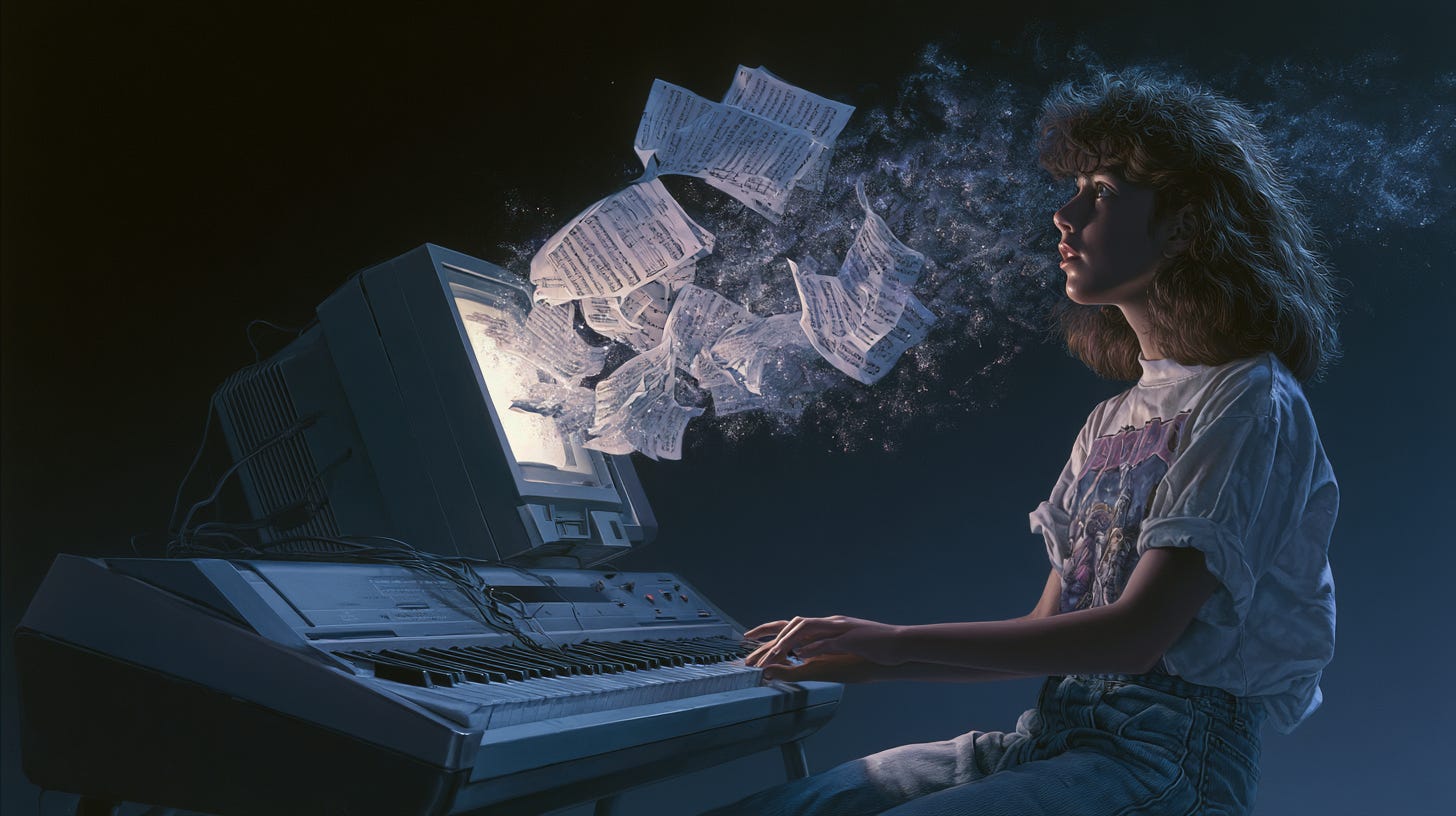
Magic was happening before my eyes. And more importantly, I got my time back. Time I could now spend composing and producing instead of transcribing. The MIDI card didn’t write my music. It handled the part that was getting in the way of my creative process.
I’ve been thinking about that moment a lot lately, because I’ve been deep into MidJourney animation. And I cannot get it to do what I want it to do.
You want to know why?
Because I am not a digital animator. I don’t understand the technology, the terminology, or the unwritten rules. To a professional animator, MidJourney is handling the tedious parts of their craft, the “sheet music” parts. The parts that eat time without feeding the work. But I don’t know enough about animation to even identify what those parts are. So I’m fumbling through MidJourney getting amateur results, wondering why the magic isn’t happening.
The MIDI sound card didn’t make me a better composer because it was powerful. It made me a better composer because I already was one. I knew music theory. I understood structure, melody, and harmony. I knew what I was trying to say before the tool ever entered the room.
Technicians — animators, software developers, marketers, product managers, doctors, lawyers, writers — are not going to lose their jobs to AI. Not the ones who understand the core of what they actually do. If you know your craft at a molecular level, AI becomes exactly what that MIDI card was for me: the thing that handles the sheet music so you can get back to the song.
I want to acknowledge the fear behind AI, as I’m just like all of us in this day and age - I’m trying to figure it all out. I see the benefit of it, but I know it is not all puppies and rainbows. AI is also making us lazy in ways that sadden me. We are losing our curiosity. We are outsourcing our critical thinking. But, to be brutally honest, AI is not responsible for starting that slide. Smartphones put us on that slide 25 years ago. The dependency on computers to do our thinking was already well underway before ChatGPT, Claude, or Gemini was even a concept.
The Call to Action for Artists and Technicians Alike
Don’t resist AI because you think it’s going to take your job or kill your craft. Resist letting any technology do your thinking for you. Learn what your superpowers are without the tools. Hone them. Really lean into them. Because when you know what you’re actually made of, you’ll know exactly how to use AI to put your own unique, irreplaceable songs on sheet music.