


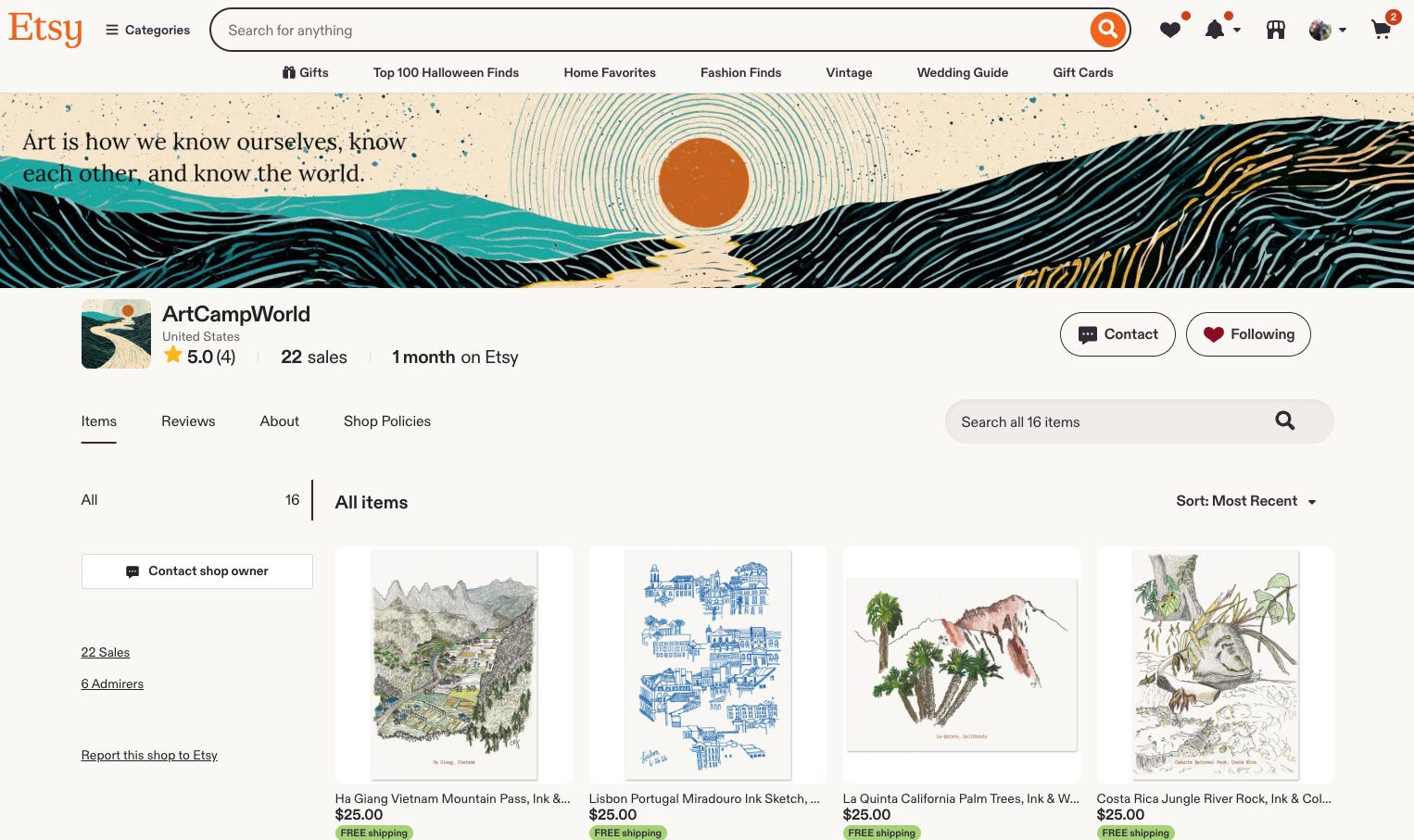
I made something! The Art Camp World shop on Etsy is officially open. Take a look here.
I never meant to sell art. Hell, I never meant to really make art for the world to see. This all started as a way to hold on to a trip-of-a-lifetime.
From January through April this year, I traveled through Costa Rica, California, Singapore, Cambodia, Vietnam, Thailand, the Philippines, Bali and Sri Lanka. I brought a sketchbook, a few colored pens and pencils, and a travel watercolor set. I wasn’t trying to become a “real” artist. I just thought that sketching would be a romantic way to remember places in a way my phone couldn’t capture.
What I found was that an hour with a sketch gave me permission to actually look - at the infinite shades of green on a hillside in Sri Lanka, the blues in the sea near the Philippines, and shadows in rocks and trees that I hadn’t noticed before.
My camera roll reminds me where I’ve been, my sketchbook reminds me what I was really paying attention to.
Then there were the people. Almost every time I sat down to draw, someone stopped and asked for a peek. They told me about their town, their own trip, the relative who used to paint. Sometimes, to my shock, they wanted to page through my whole sketchbook. They saw things that I didn’t and made me love the sketches and places even more. Each page holds a place and the people around me when I drew it.
When I got home, I didn’t want those pages to live on a shelf. I wanted them out in the world, doing what they did on the road: starting conversations. So I turned them into prints.
The shop opens with 16 sketches (with many more to come).
Many Lessons Learned
I assumed putting a few prints online would be easy. The tools (social media, Canva) and systems (Etsy, and Gelato, my print-on-demand provider) are all out there, ready to use. Separately, many are brilliant. Fitting them together is another story. Here’s the learning curve from the inside.
1. There are too many tools, and AI has made it wilder. Video, audio, scheduling, captions, keywords, titles… every week brings ten new AI tools promising to do all of it, and few clear winners. Analyzing them all has become a part-time job. I’m trying to keep this as human as possible while being smart with my time and money.
2. Photoshop is a product mystery. Its the #1 tool in its market for what it does, and one of the least intuitive pieces of software out there. It assumes expert-level literacy in color theory, masking, and vector paths. I’m learning it all one YouTube tutorial and one AI conversation at a time.
3. “Museum quality” is a whole education. Paper, color, resolution, scanning, and why colored pencil looks perfect on screen and a little different on paper are things I’ve never given much thought to before this project started. Getting the texture of small sketches to survive the trip to print took more more trial and error than I expected.
4. Great customer experience when you don’t control customer service. Gelato prints and ships my orders, which makes a one-person shop possible, but customer obsession was one of my hallmarks as a product leader, and I won’t let it go. It feels like any gains I’ve made with AI tools, I’ve lost arguing with support bots. Reaching a human is nearly impossible, and that’s on purpose. (There’s a business idea in here somewhere, but I’m a little busy with something else right now.)
5. I launched it like a product. Before opening the shop to everyone today, I ran a friends-and-family soft launch: real people, real orders, the whole experience tested end to end. This alpha test caught glitches in my branded packaging I never would have found alone. Thank you, early buyers. You were my QA department, and you didn’t even get cool swag.
6. Building a brand means taming my own brain. I did the unglamorous work of writing a messaging pillars doc, designing a logo, picking brand colors, defining a brand voice (playful and bold), and creating a social media schedule. My brain always wants to try something new. That’s a superpower, and also one that will drive a new brand straight into a ditch. Consistency is the least exciting thing I’m doing, and probably the most important.
Where Art Camp World is going
The shop is the first piece of something bigger.
“Art Camp” isn’t my phrase. It belongs to my Aunt Betsy, a lifelong NYC artist and former art professor, who has used it for years to describe the play, curiosity, and real conversation that show up when people make art together.
Art Camp World is built on three ideas: know yourself, know your world, know each other. Here’s the roadmap, product-person style:
Now: a shop of my own travel sketches.
Next: a shop that sells work from other artists, so they can make art instead of wrestling tools and systems to make a living.
Later: Art Camp, a physical artist residency and retreat, with room to stay, studio space, and workshops. Come as you are, make what you make, and talk about it.
If you read my earlier post about becoming an Artrepreneur, this is that word in practice: using everything I learned building products to help art reach the people who’ll love it.
Come to Art Camp World!
Visit the shop here. If a sketch speaks to you, bring it home. If you love it, leave a review and/or like the shop (this helps more than you know).
Keep a travel sketchbook? Send me a page, or tag @art.camp.world on Instagram.
Share this post with the friend who always doodles on the napkin.
Wherever you come from, and wherever you’re going, there is art to make and people who want to talk about it.