

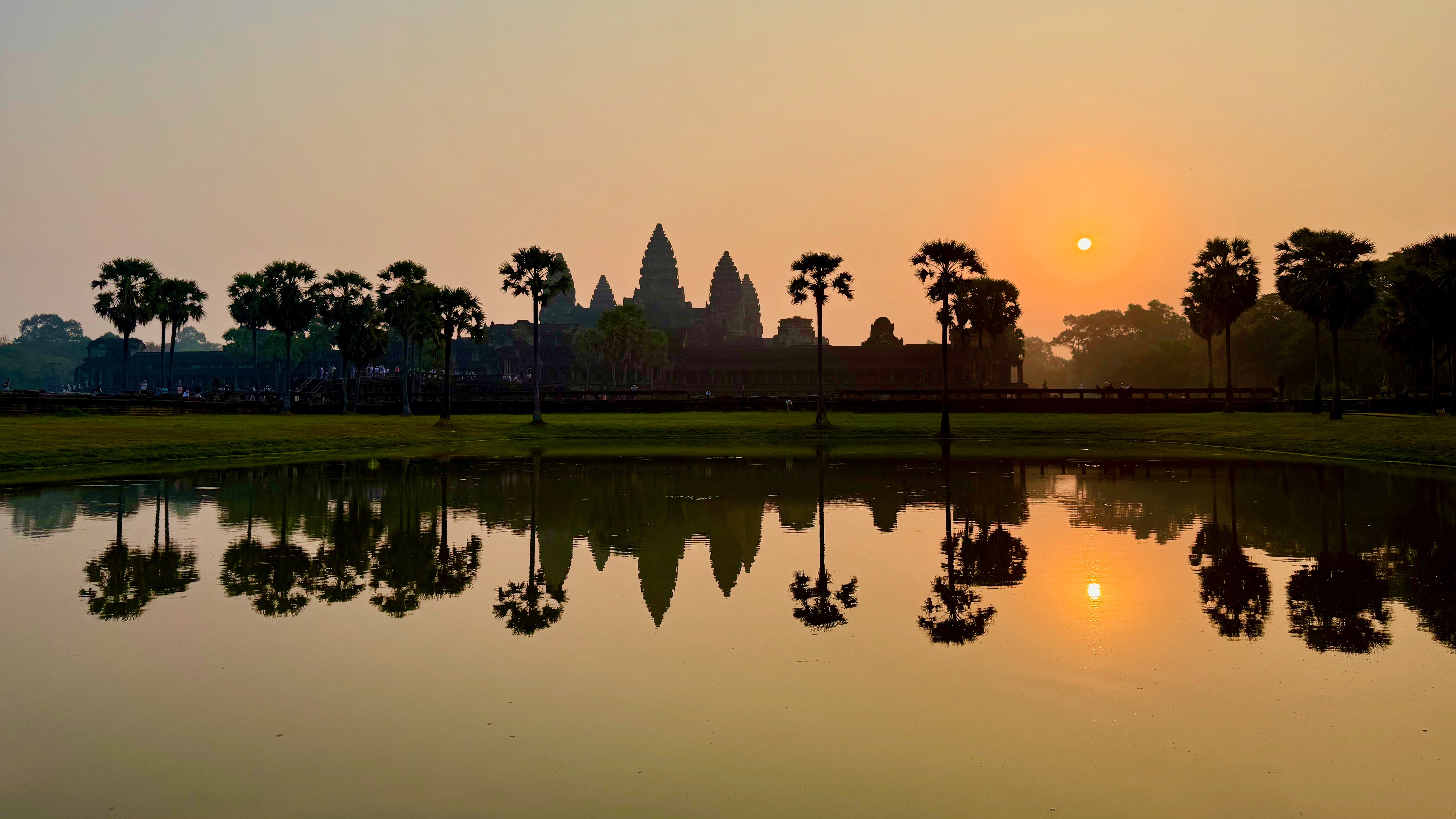
Siem Reap, Cambodia was the fifth city visited in my sabbatical travels. As I write this, I am 43 days into the trip. During my 4 days in Siem Reap, I finally felt myself unwind and feel without an undercurrent of tumult or desire to troubleshoot and fix something.
Perhaps the benefits of my meditation & gratitude practice started kicking in. Or maybe the supportive messages from home were the pick-me-up I needed. Or the Chinese herbs that I got from an acupuncturist in Singapore settled my nerves. Or the comfortable king-sized bed that enabled the much-needed catch-up on my slumber.
Maybe it was all of these things, as well as the Cambodian hospitality, radiant smiles, peacefulness, and friendliness.
Cambodia captivated me in many ways and I’m going to need to unpack it in a few different posts, so I’ll start with the obvious…
The Angkor Wat Temples were a dream-come-true
I can’t remember the first time I heard about Angkor Wat, or what it was about it that called to me. In fact, on my trip over here, I was day-dreaming about seeing the temples for the first time, and the goose bumps that formed on my body were halted by the striking reality that I did not know the first thing about Angkor Wat, other than the airport I needed to fly into to see it. In other words, I blindly followed my heart and intuition here … how cool is that?
Turns out that Angkor Wat was as mesmerizing as I had hoped it would be. For most of my life, I’ve been enchanted with Eastern religions and have never thought to unpack the reasons why, but I did on this trip and here’s what I figured out: Everything - I mean everything - in Eastern religions has a meaning; a good luck charm, a protective force, a worshipping of nature, a strength-builder, etc. And all of these symbols have a magical story behind them that explains the meanings and provides both tangibility and intrigue.
The temples of Angkor Wat are a grand-scale manifestation of all of this. The temples, built from the 9th-13th centuries, were a site of prayer, school, and burial. There are plenty of sources far more knowledgeable about Angkor than I am, so I’m not going to recount all of the facts I learned - however if you come upon an Angkor Trivia Night and are feeling competitive, I’m the woman you want on your team 🥇
There are several impressions that Angkor left me with -
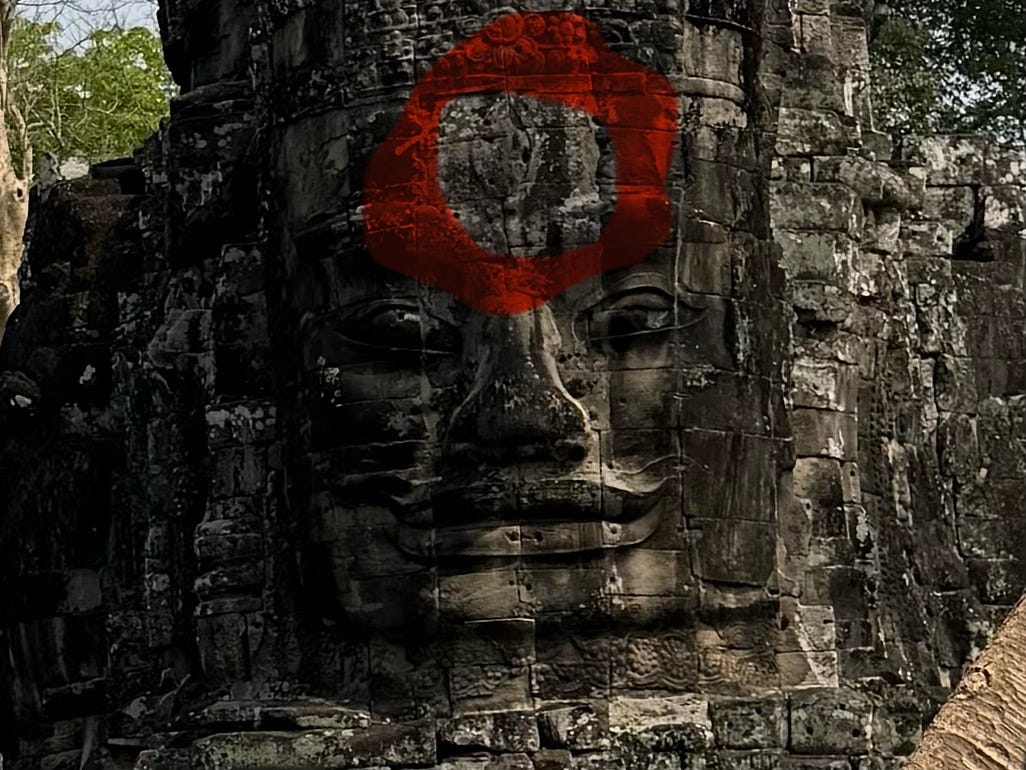
The temples embody a centuries-long tug-of-war between Hindu and Buddhist rulers. Each ruler defaced, rebuilt, or modified the temples if he worshipped a different god than the king before him. One example of this is in the photo below - This is a Buddha at the gate of Angkor Thom. See the third eye, circled in red? That was put there by the Hindu king who followed the reign of the Buddhist king before him. In a way, the fight between the two religions just ended up creating something better than the original. What started as erasure became layering, and the temples are richer for every king who thought he was winning.
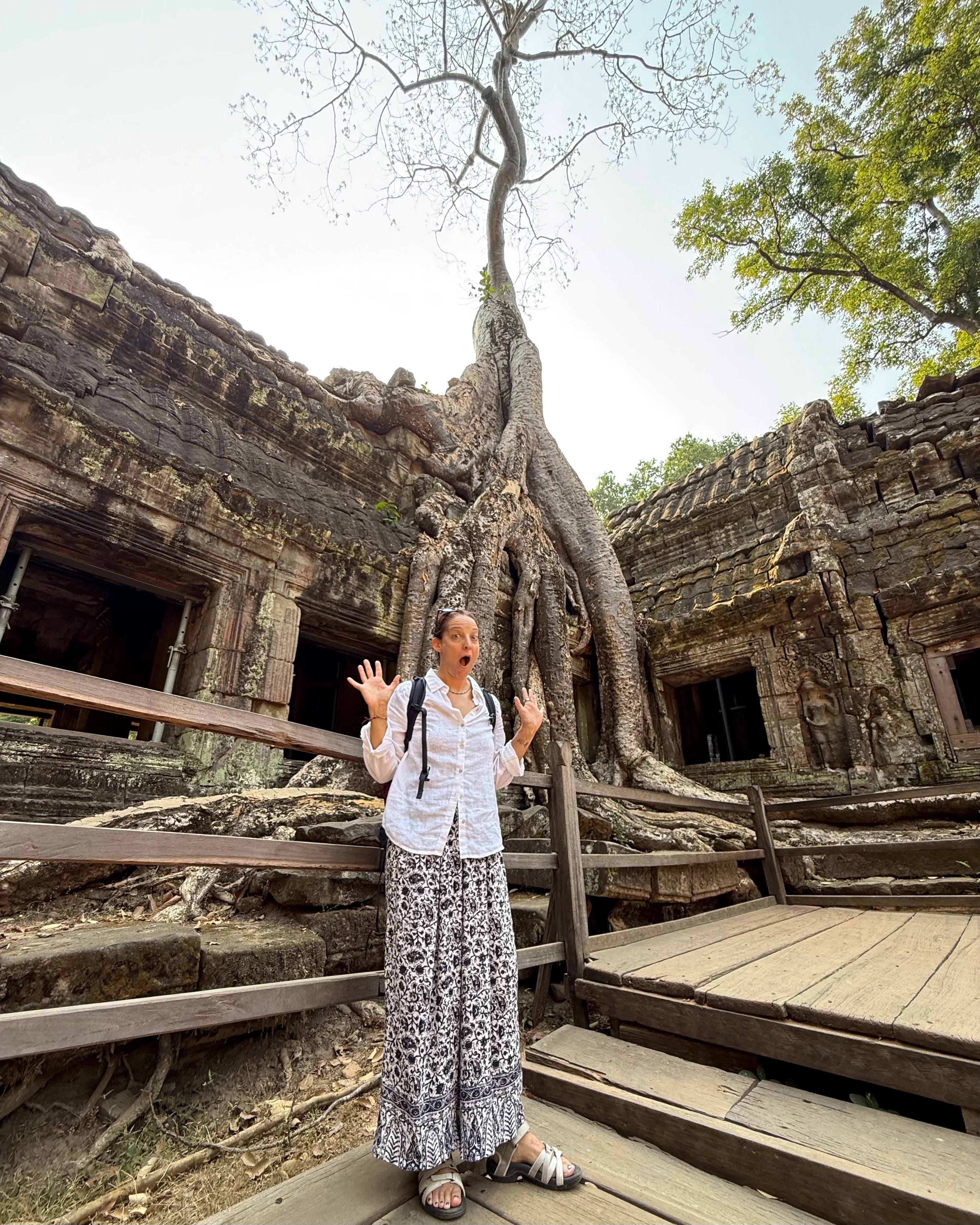
Man vs. Nature literally oozes at Ta Prohm, aka “The Tomb Raider temple.” Man built the temples, and then the trees stubbornly and fastidiously grew in, around, and over them, their roots covering the stone like lava. And while the trees claim their space, man must continue to work to protect the temples from the determination of the trees that are now as much of an attraction as the sandstone structures themselves. This particular tree is iconic:
This brings me to my next insight about how in the holy hell these structures were even built, as it is an unfathomable feat, likened to mysteries like ‘How do planes fly?’, or ‘How do ships float?.’ The Angkor temples were built by brute force from kings’ slaves who excavated stone and elephants who carried the materials from 60-100km away (which begs, why didn’t they just build the temples 60-100 km away? why all the transport? 🤷🏻♀️ ) As you could imagine, the building - at least the maintenance - continues today. Thankfully, we’ve moved beyond slavery to maintain the temples, but there are hundreds of thousands of humans contributing to the upkeep of Angkor through university programs, volunteerism, UNESCO, and local work crews. In the video below, I captured a crew from a university in South Korea. (I asked my guide, Sokpee, what they were talking about - the leader was talking to the crew about his concerns of the heat, ensuring that they were done by a certain time and that everyone was taking care of themselves. And they did a warm-up before they started working! I loved seeing the care they had for each other ❤️) -
One more thing … AI Angkor?
After touring the temples, I’ve been obsessed with the idea of an AI recreation of them. I would love to see what they looked like, painted in bright crimson and marigold, and the burial chambers adorned with the kings’ walnut-sized rubies and sapphires embedded in the walls. The deteriorated palette of stone grays and mossy greens has its charm, but it seems like the originally-decorated temples were a spectacle to behold. I found this “Virtual Angkor” project, but its not exactly what I had in mind. I’ll keep searching - please put links in the comments if you come across anything that resembles AI recreation of Angkor Wat.
My Angkor Photo Album
There are too many photos for me to put in this post, so I’ve put them all on a public Google Photo Album, which you can access here. Happy photo-gazing!
Part 2 (and maybe 3)
Here’s the teaser for the reflections on Cambodia I will continue in Part 2 -
My time in Cambodia inspired some career introspection on how I could use my product leadership skills, knowledge, and superpowers to build products and business that prioritize human connection and wellness over wealth.
I went on a really unique countryside bike tour that I can’t recommend highly enough if you are ever in Siem Reap. It gave me an up-front look at the beautiful Cambodian people and their life in the countryside.
The universe also connected me with a bunch of people in Siem Reap. I am beginning to think of these strangers met along the way as my “travel companions.” More on this later.
Lovely, this whole post. This is giving me a lot of life as I plod through my dreary duties. Can’t wait for the next installment!