

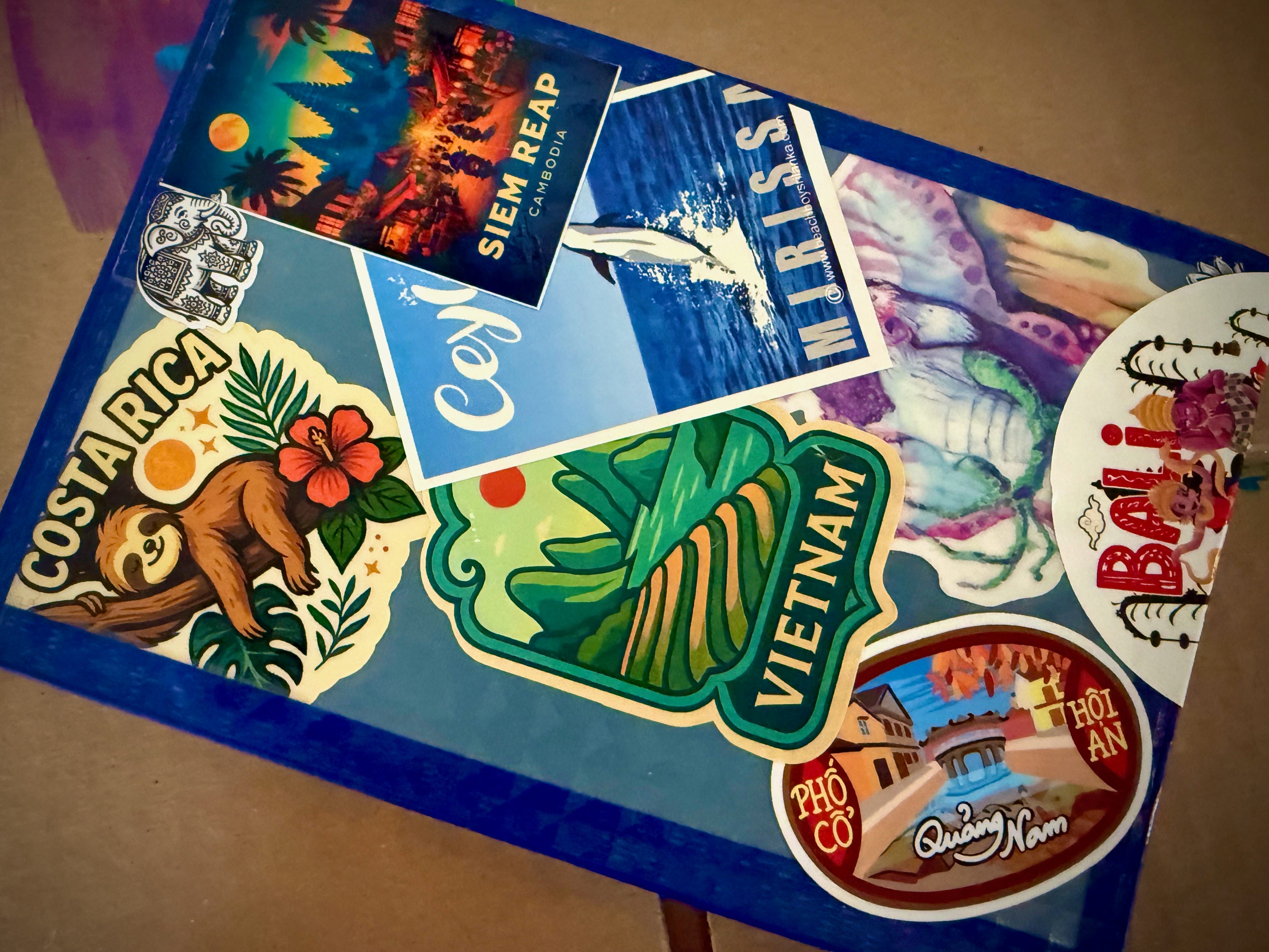
I started carrying a sketchbook with me when I moved to NYC. I was inspired by my aunts, Betsy and Andee, who have done this as far back as I can remember. I told myself I don’t draw, I doodle. The sketchbook gave the shapes and colors in my head a playground where they could come to life.
In my recent travels, I carried it with more intention. Little by little, one line, one shape, one shadow at a time, I learned to draw actual things. I sketched nearly every day — not to master a craft, but for the pleasure of seeing the world differently and capturing it somewhere other than on my phone.
I did this with childlike play and curiosity. I expected I may get a little better at it over time, but what I didn’t expect was what happened every time I sketched in public. People stopped. They glanced. They started talking to each other and to me.
In Cambodia, I watched the sun rise over Angkor Wat with my sketchbook open, roughly sketching the shape of the temples, the river, and the big red orb rising before me. A couple sitting next to me glanced over. I heard the woman say quietly to her husband, “I wish I could draw.” I couldn’t help myself. “You can,” I said. “You just might not know it yet.” They laughed, complimented my “talent” — a word I always push back on when it comes to my drawings. I commented on their American accents, and we launched into a conversation that was immediately interesting and meaningful.
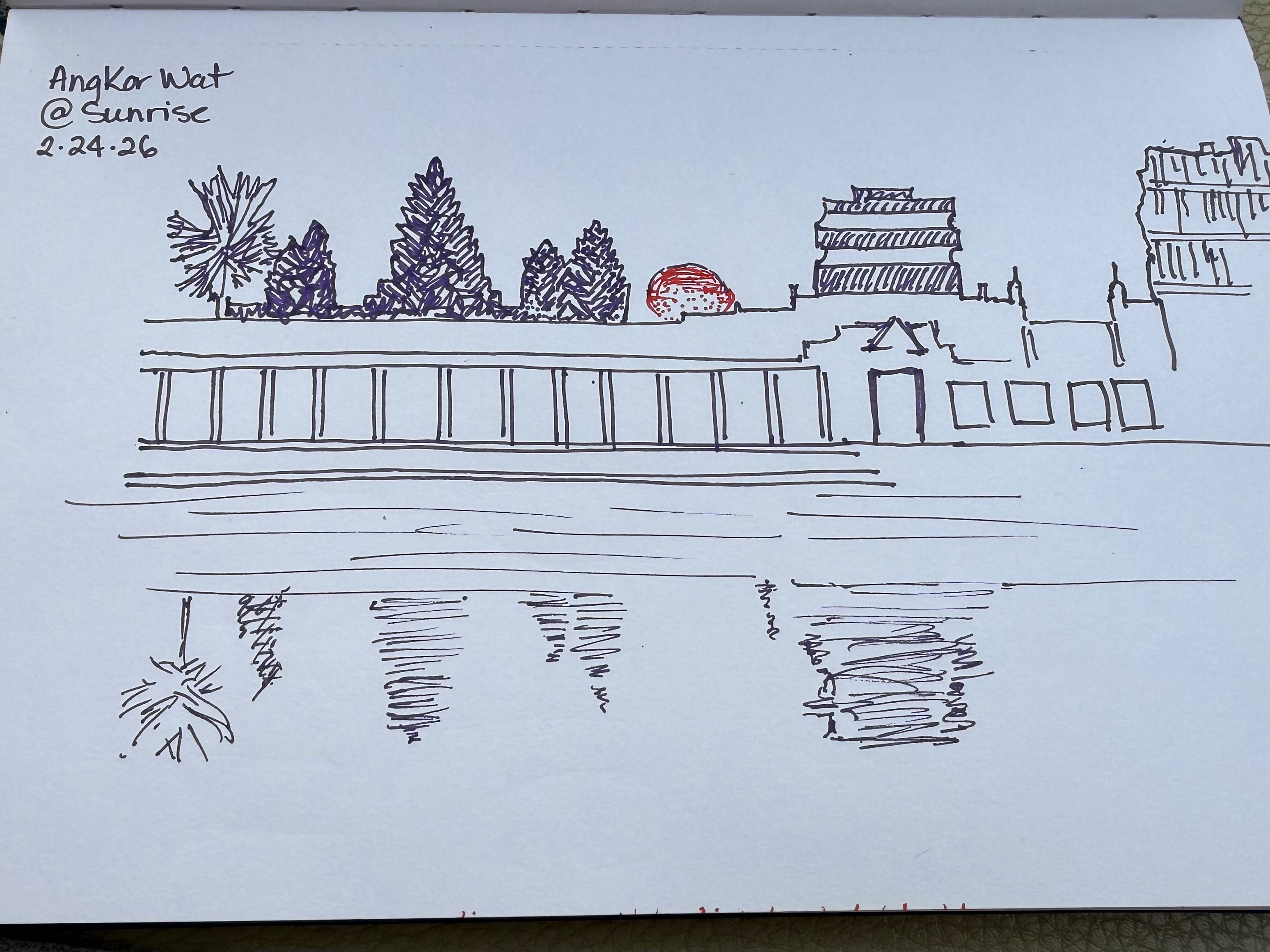
The three of us watched the sun come up together, and then we went our separate ways into the temple ruins. That night, at a random restaurant on Pub Street — a busy, touristy street in Siem Reap — I sat down with a view of the street and was just about to open my sketchbook again when I noticed them. The same couple, being seated at the table right next to mine. What are the chances?! I joined them for dinner. Art brought us together.
It happened in Vietnam. In the Philippines. In Costa Rica. In Thailand. Consistently, reliably, almost without exception: the sketchbook was a magnet.
One of the greatest compliments I received was a request from a fellow traveler for me to sketch something in his travel journal. Imagine — my drawing is etched in his chronicle of his latest vacation. How freakin’ cool. What an honor. 😍
There is No Wrong Way to Make Art
Somewhere between childhood finger-painting and adulthood, most of us absorbed the idea that art belongs to artists — a separate class of humans who were born with something we weren’t. And so we stopped. We became observers instead of makers. Consumers instead of participants.
Art, in its original and most essential form, has never been about mastery. It’s been about meaning-making. Looking at something — a sunset, a building, a face, a feeling — and expressing something. The impulse is human. It predates language.
There is no right way to make art. There is no wrong way to look at it, talk about it, or be moved by it. The only thing you can do wrong is convince yourself it’s not for you.
Human Connection Happens in the Flesh
My sketchbook drew me to strangers, who became new friends, reliably. I have not connected with nearly as many people through dating apps, Instagram, or any other digital community as I did with art.
We can connect through a screen. I’ve done it. I do it. This Substack is, in a certain sense, a form of connection — you’re reading words I wrote, something in them resonates, and that resonance is real. But it is a different animal from what happens when two humans are face-to-face, flesh-to-flesh, in front of a shared thing, talking about it together.
When you’re sitting next to someone, you can observe their gaze as they speak. You can see the nuances of their face and body language. You feel their energy when your eyes lock, however briefly. You can see that they are not performing to pacify an algorithm. They are practicing humanity.
Art is social infrastructure that gives us joint purpose.
Rebuilding Our Humanity
Our lives have become swallowed up by computers and devices instead of being fed by in-person human connection. We are more connected than ever, by every measurable metric, and somehow also lonelier. The research is grim and consistent: loneliness is at epidemic levels across age groups, countries, and demographics. Digital connection is real and it helps. But it is not how humans are meant to connect. We are walking around, many of us, chronically underfed in a specific and essential way.
Even though — maybe because — I’ve made a career in technology, I’m motivated to reverse this trend and rebuild our humanity.
What I build next will be centered on a mission of human connection. It won’t scale like an app or deliver a 10x multiple. It doesn’t need to. I’m not building for extreme wealth. I’m building for our humanity.
Art — visual, musical, culinary, literary, physical — has always been the mechanism by which humans recognized each other as fully human. A work of art says: I noticed something. I felt something about it. I made this so you could feel something too. And when it works, even imperfectly, it creates a bond that transcends the specific object. It says: we are in this together. We are made of the same stuff. We see the same world, even when we see it differently.
That’s not a luxury. That’s not a business. That’s not even a product. That’s a fundamental human need.
The path back runs through the art all around us — and the art we are in the process of creating.
So, dear humans, go forth! Be human! Make something. Share it. Let someone react to it. Look at what they make. Tell them what you see.
Love this one, you are doing *the* work! And it’s amazing to witness. Thanks for sharing your words with us. 💕
Cortney, I love this.